
SOFIA DEVELOPMENT ASSOCIATION was founded as non-profit organization with the decision 348
of the Sofia Municipal Council to work for the sustainable development of the capital.


Shortcuts
BEREADY PRESENTED IN THE 26TH STEERING GROUP MEETING OF EUSDR PA5
 The 26th Steering Group Meeting of EUSDR Priority Area 5, organized on 21 November in Hungary, was an opportunity for projects funded by the Danube Region Program in 2024 to present their priorities and progress thus far. Sofia Development Association, the lead partner of the BeReady project, took part in the event and highlighted the results achieved in the first 11 months of implementation.
Focused on urban heat islands (UHI), BeReady tackles critical climate change issues in urban environment and aims to promote policy and technological solutions for adaptation. The city partners have already engaged in UHI risk assessment and vulnerability and held methodology workshops with local stakeholders to plan the process of urban climate data collection and analysis. Through local coalition pacts, BeReady encourages wide public engagement and the involvement of quadruple helix organizations in the risk assessment; over 95 external organizations have signed the local coalition pacts. The first results of the UHI assessment reports will be available in January 2025 and will serve as the basis for planning the city pilot actions: they will encompass innovative acupuncture methods, focused on blue, green, and white technological and infrastructure measures to reduce the effect of UHI.
To stay informed, please visit the website and the social media accounts of the BeReady project: website (https://interreg-danube.eu/projects/be-ready ), Facebook https://www.facebook.com/bereadyprojecteu, LinkedIn (https://www.linkedin.com/company/beready-project/.


Be Ready is an INTERREG Danube Region project co-financed by the European Union.

GENDERED COALITION PROJECT RELEASES CROSS-COUNTRY POLICY BRIEF THAT HIGHLIGHTS GOOD PRACTICES TO COMBAT ONLINE GENDERED DISINFORMATION IN EUROPE

The GenderED Coalition Project, a European collaborative initiative involving partners Forma.Azione, the Daissy Research Group of the Hellenic Open University, Savoir Devenir, Sofia Development Association, and the Bureau for Integration and Social Innovations, has released a cross-country policy brief on the topic of gender disinformation and misogyny, The brief, accessible at www.genderedcoalition.net/cross-country-report, brings together good practices identified across Bulgaria, France, Greece, and Italy to combat online gendered disinformation.
The document outlines findings from a comprehensive analysis of 20 projects designed to enhance Media and Information Literacy (MIL) through gender-sensitive strategies. This initiative reflects the GenderED Coalition’s commitment to advancing gender equality and democratic values by promoting resilience to gender disinformation.
Key Findings
The analysis addresses four main dimensions within the context of gendered disinformation:
- Project Types – Most initiatives center on resources and direct engagement, with a significant focus on youth, even as educational curricula lag in gender and MIL integration.
- Competence Frameworks – Gaps in the visibility of MIL frameworks persist, with a need for greater inclusion of critical thinking, participation, and intercultural dialogue.
- Capacity-Building Instruments – EU policies play a crucial role in structuring projects; however, comprehensive frameworks and evaluation standards remain inconsistent.
- Stakeholders and Networks – Public institutions and educational entities are leading actors, while media engagement varies widely, highlighting an opportunity for strengthened partnerships.
Recommendations
The brief also proposes targeted actions to guide policy improvements and institutional support for combating gendered disinformation across the EU. Among the eight key recommendations are the development of unified competence frameworks for MIL and gender literacy, the establishing of baseline evaluation metrics to ensure effective project outcomes and also providing cross-national research funding and detailed monitoring systems to strengthen policy responses.
For more information on the GenderED Coalition Project and to read the full policy brief, visit www.genderedcoalition.net.

THE PROGRAM "CAREER OPPORTUNITIES FOR PEOPLE 50+" STARTS WITH A COURSE ON PERSONAL SKILLS

On November 8, 2024 Sofia Development Association launched the training program "Career Opportunities for People 50+" developed within the SYNCLUSIVE project.
The program is designed for people over 50 years of age who are looking for new career opportunities and ways to improve their qualifications and competitiveness in the labor market. Snezhina Gabova from SDA and Maya Tsaneva from Young Talents+, SDA’s partner in the initiative, presented the SYNCLUSIVE project and the program objectives. The first program course, Personal Skills and Motivation, aims to help participants learn how to deal with major challenges in the labor market related to personal effectiveness, sustainability, change management, leadership and teamwork.
The instructor, Julia Simeonova, introduced participants to various techniques for personal and professional development, focusing on several key topics:
- Developing a personal portfolio. The participants analyzed their strengths and weaknesses and formulated personal goals with guidelines for future development.
- Effective interviewing techniques for both online and in-person job interviews.
- Time management and work-life balance. Through tools such as the Eisenhower Matrix, the Pomodoro Method, and the Pareto Principle, participants learned to optimize their time and achieve a better work-life balance.
On-site and online training sessions are planned for the next two weeks, during which participants will engage in more activities to improve their skills in a professional environment.
The program "Career Opportunities for People 50+"continues with a digital skills course, starting on November 19. If you are over 50 years old and want to improve your skills for working in a digital environment, visit the website of Sofia Development Association and sign up for the course.
The SYNCLUSIVE project is funded by the European Union's Horizon Europe Research and Innovation Programme.


This project has received funding from the European Union’s Horizon Europe research and innovation programme under grant agreement No 101094526
THE FINAL EVENT OF THE PLOUTOS PROJECT WILL TAKE PLACE ON DECEMBER 6 IN BRUSSELS AND ONLINE

The PLOUTOS project is coming to an end, and the final conference will be held on December 6, 2024, in Brussels.
This project supports third-country nationals with financial literacy, entrepreneurial skills, and integration support!
At the final conference, you will have the opportunity to meet with representatives from European institutions and organizations dedicated to social and financial inclusion. Exchange best practices and see how you can contribute to building a more inclusive society.
You can join the event online after registering here: https://forms.office.com/Pages/ResponsePage.aspx?id=zhvpK3luNk-VWu2io9A1yJZN7IAw1lBLkD5AoJ7P4TVUMThORkEzVUVQT01KMFRQMlRCRDRZVU4wQy4u
The conference agenda can be viewed here:
https://ploutosproject.org/wp-content/uploads/2024/10/Agenda-PLT-V5.png
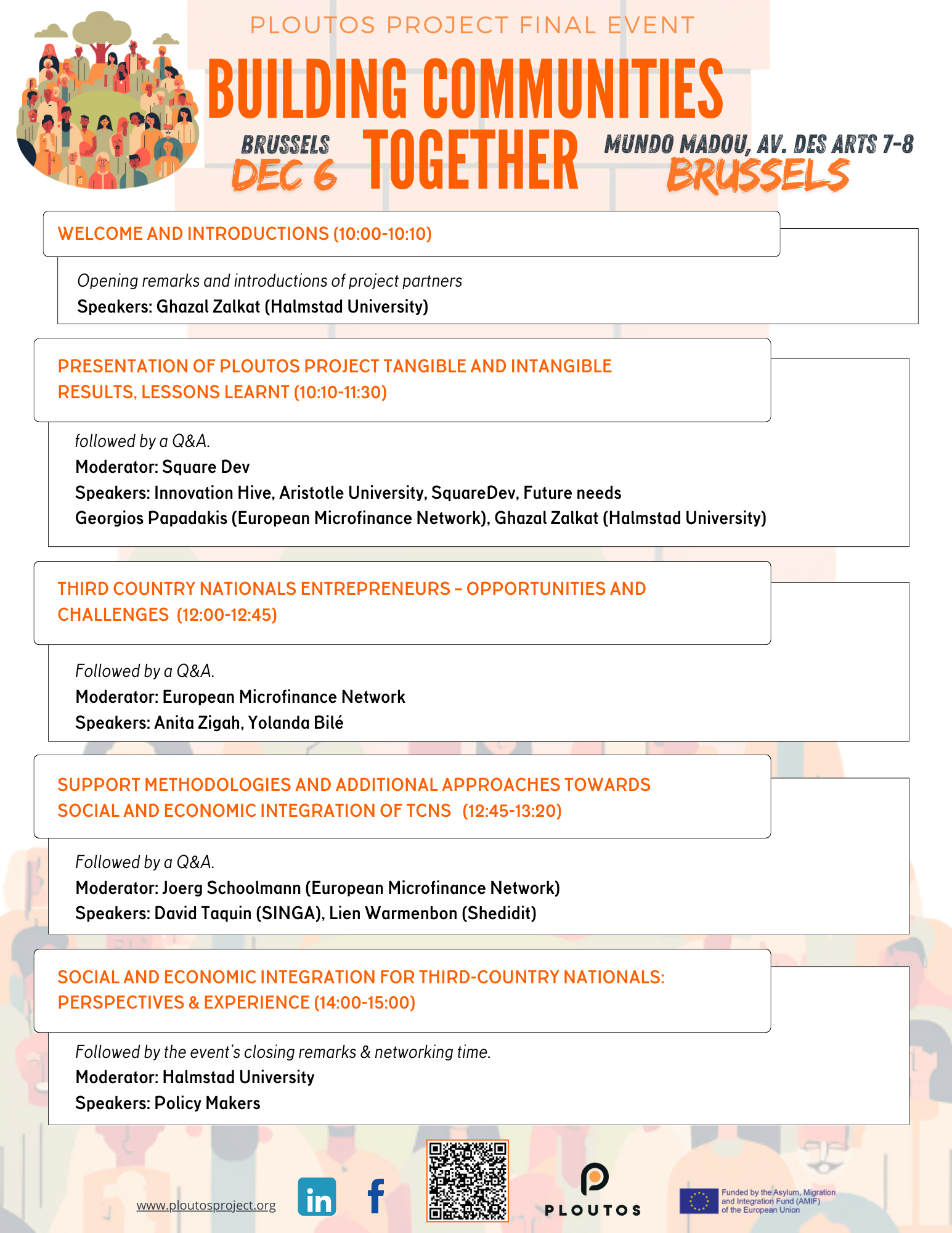
PLOUTOS is implemented with the support of the European Union’s Asylum, Migration and Integration Fund.

SOFIA SHOWCASED AS AN AI FRONTRUNNER AT THE 24th CoR ECON CONFERENCE
 With the recent adoption of the Artificial Intelligence Act, public administrations at all levels will increasingly need to invest resources into the adoption of Artificial Intelligence (AI), enabling them to provide public services to citizens more effectively and efficiently. Contrary to the commonly held opinion, evidence has shown that the use of AI in the EU public sector is not lagging behind its use in other sectors. In addition, the use of generative and predictive AI has increased throughout 2023. Since Open AI launched their large language model Chat GPT at the end of 2022, the general public has become aware of the practical use of AI, leading to an AI boom which has by now made AI central to the digital transformation of society, and an EU priority.
In order to contribute to the central discourse on the use of AI by public administrations at subnational level, the European Committee of the Regions and its Commission for Economic Policy organized a conference hosted by the city of Tampere, Finland, on October 25, 2024, entitled “Digital transformation as a changemaker for cities, companies and local and regional economy”. It aimed to examine EU actions to boost the use of AI by cities and regions. The conference also seeked to facilitate linking up engaged cities and regions and offer recommendations on how politicians and practitioners could pool resources to propel the integration of AI across EU cities and regions.
Four early adopter cities and regions were invited to showcase inspiring initiatives supporting the adoption and rolling out of AI in public administrations at local level – Sofia, Munich, Tampere and the Galicia region. Sevdalina Voynova presented the experience of Sofia Municipality as a forerunner in using AI for on-demand public transport, allowing to bridge the widening digital gap in AI use. The pilot was designed and implemented in the framework of INNOAIR project, funded by the Urban Innovative Action initiative.
The experience and lessons learned from the showcased cities and regions added to the Committee of the Regions opinion on Challenges and Opportunities of AI in thePublic Sector: Defining the role of regional and local authorities.


NEW CAREER OPPORTUNITIES FOR PEOPLE AGED 50+ IN THE JOB MARKET
 The initiative to facilitate easier access to the job market is implemented by the Sofia Development Association and the Young Talents Bulgaria platform.
On October 25, 2024, the opening event of the new initiative "Career Opportunities for People 50+" by the Sofia Development Association and Young Talents Bulgaria took place at SofiaLab. The initiative aims to provide people in this age group with access to targeted skill acquisition training, as well as career and psychological counseling.
At the opening event, key speakers outlined the development plan for the initiative. Ekaterina Yordanova, Chair of the Sofia Development Association Board, emphasized the importance of supporting pre-retirement age individuals, stating that "there needs to be a link between institutions, people, and employers to fully utilize the potential of this group. Two key steps are necessary to achieve these goals—education and targeted thematic training."
Following this, Snezhina Gabova from the Sofia Development Association and Georgi Parvanov from Young Talents Bulgaria presented the main goals and phases of the "Career Opportunities for People 50+" initiative. “The world is changing, and so is Bulgaria. Fifty is the new thirty. Our goal is to make age irrelevant in the job market by 2030,” Parvanov shared.
Over the course of one year, the training program will support at least 50 people through courses focused on digital and green skills, personal development, and professional support.
Smilen Valov, Executive Director of the Employment Agency, noted that the agency offers numerous tools to support the employment of people aged 50+. "People over 50 are the future of the labor market. This group has discipline and experience, making them highly desirable to employers," he said.
During the business collaboration panel, Plamen Vasilev, Director of Human Resources at Holcim Bulgaria, reinforced the importance of including older employees in the modern workforce. He added that this group has tremendous potential, as people over 50 are disciplined, goal-oriented, and loyal to their employers.
Those interested in the program can learn more on the Synclusive Project website: [https://synclusiveproject.eu/?p=4222](https://synclusiveproject.eu/?p=4222).
The campaign is part of the broader framework of the Synclusive project, which aims to promote the inclusion of vulnerable groups in the labor market. The project is funded by the Horizon Europe research and innovation program of the European Union.


This project has received funding from the European Union’s Horizon Europe research and innovation programme under grant agreement No 101094526